The case for one notebook and no app
I have tried every task manager released since 2005. The one that lasted is a paper notebook and a weekly hour.

In short
- Every task app optimises for capture. Capture was never the problem; deciding is.
- A list with forty items is a list with none.
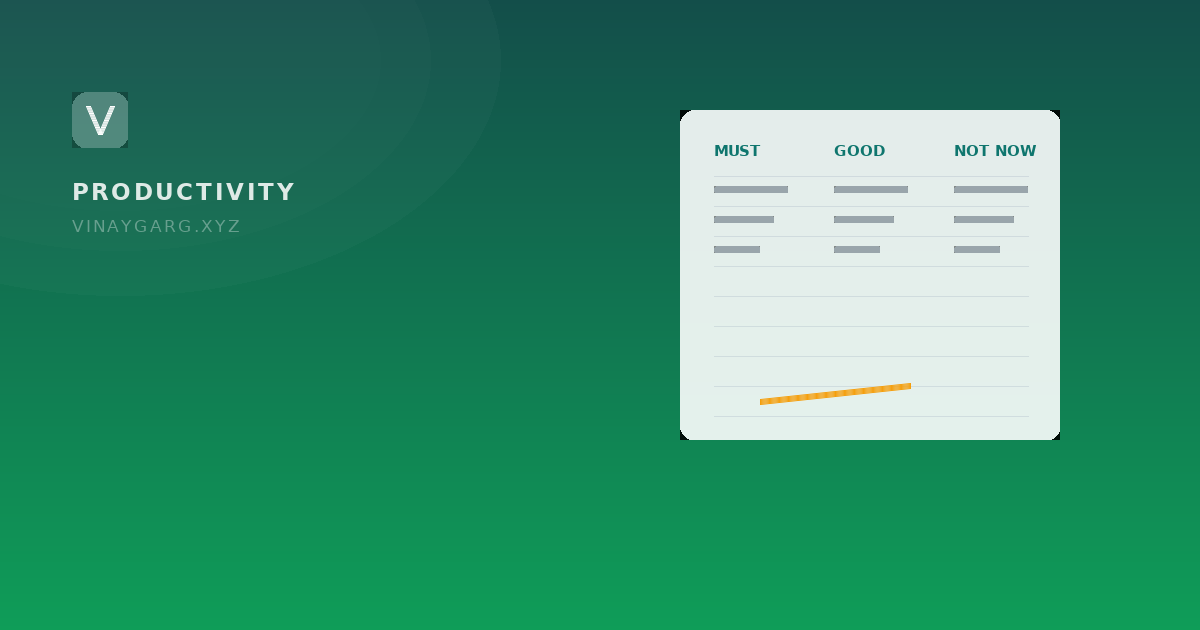
- One page per week, three columns: must happen, would be good, deliberately not doing.
- Anything untouched for three weeks is crossed out, not migrated.
3
columns every week: must, good, not doing
system
1 hour
weekly review, Sunday evening
system
3 weeks
untouched item is crossed out
rule
A confession from someone who teaches software: my most reliable productivity system has no sync, no notifications and no subscription. It is a bound notebook, a pen, and one hour on Sunday.
Why the apps kept losing
Every task manager I used optimised for capture. Capture was never the problem — I am excellent at capturing. The problem was deciding, and no app will decide for you. What they do instead is let you postpone the decision indefinitely, with a badge count as encouragement.
- Inbox zero is a hobby, not an outcome.
- A list with forty items is a list with none.
- Notifications convert attention into a reflex.
What the notebook does differently
One page per week. Three columns: what must happen, what would be good, what I am deliberately not doing. Anything that survives three weeks without being touched gets crossed out, not migrated. The friction is the feature.
A system you can complete is worth more than a system that can hold everything.
The weekly hour
Sunday evening: review the week, copy forward only what still matters, and write the one thing that would make the coming week feel like it counted. Then close the book. The rest of the week is execution, not administration.
I still use a calendar, a text file for code notes, and the college's systems. But the decisions happen on paper, once a week, and that turns out to be enough.
Sources
- Personal practice, since 2005
Frequently asked questions
Is a paper notebook better than a task app?
Not universally. It is better for deciding, because it cannot hold everything and the friction forces a choice. It is worse for anything shared, dated or searched, which is what a calendar and a text file are for.
How do you stop tasks falling through the cracks?
One weekly review where every open item is either copied forward deliberately or crossed out. Nothing migrates silently, so nothing disappears silently.
What about work shared with other people?
Shared work lives in a shared system — the college ERP, a document, a group calendar. The notebook holds only the decisions I personally owe, so there is never a question of whose list is authoritative.
How long does the weekly review take?
About an hour, once a week. Twenty minutes to review what happened, twenty to carry forward what still matters, twenty to name the one thing that would make the coming week feel like it counted.