Lesson 24: Anonymous functions (lambda) and built-in functions
A lambda is a tiny function written in one line, useful as an argument to another function. Python also ships dozens of built-ins — len, sum, sorted, map, filter, isinstance — that save writing the obvious loop.

In short
- A lambda is a one-expression function: `lambda n: n * n` is the same idea as a def with one return.
- Lambdas are for passing a small rule to `sorted()`, `map()` or `filter()`, not for long logic.
- `map()` transforms every item, `filter()` keeps the items that pass a test, and both return iterators, so wrap them in `list()` to print.
- Built-ins such as `len`, `sum`, `max`, `sorted`, `abs`, `round` and `isinstance` are always available without an import.
1
expression a lambda may contain
Python docs
0
imports needed for built-in functions
Python docs
What a lambda is
A lambda is an unnamed function written in a single expression. It has no def, no name and no docstring, and it can only contain one expression — no loops, no assignment.
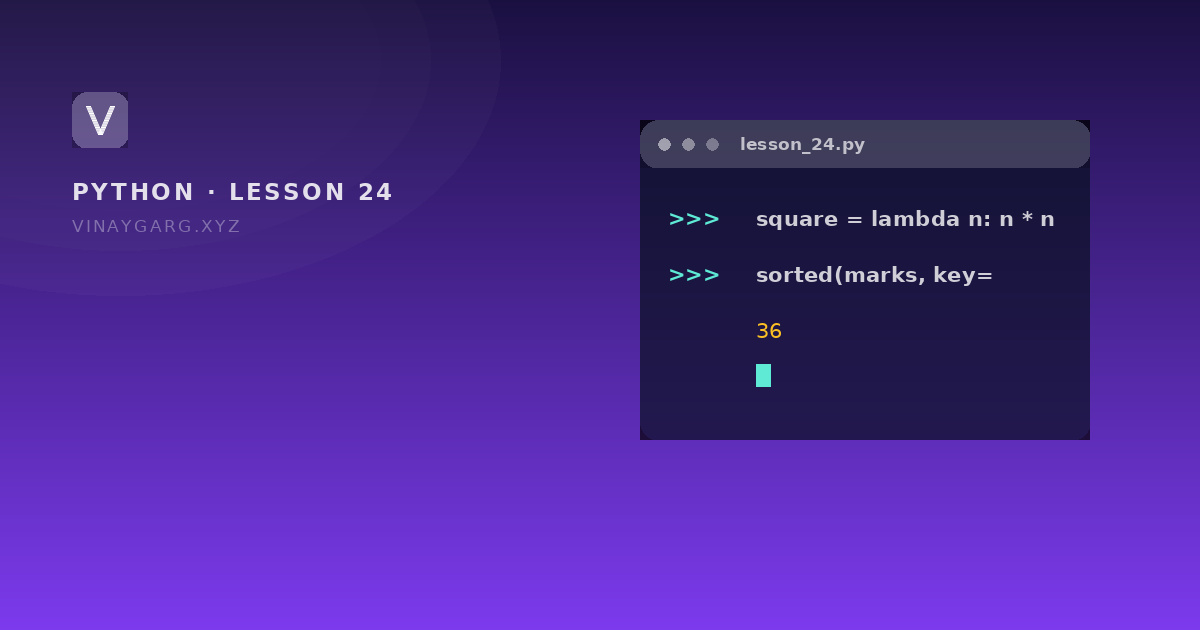
square = lambda n: n * n
print(square(6))        # 36
That line does exactly what a three-line def would do. The point is not brevity for its own sake: a lambda is useful when a function needs a small rule for one call and nowhere else.
The program
# lambda.py — small functions, and the built-ins that use them

square = lambda n: n * n
add = lambda a, b: a + b

print(square(6))          # 36
print(add(3, 4))          # 7

marks = [45, 67, 89, 30]

print(sorted(marks))                          # [30, 45, 67, 89]
print(sorted(marks, reverse=True))            # [89, 67, 45, 30]

names = ["Ravi", "Asha", "Christopher"]
print(sorted(names, key=lambda n: len(n)))    # ['Ravi', 'Asha', 'Christopher']

print(list(map(lambda m: m + 5, marks)))      # [50, 72, 94, 35]
print(list(filter(lambda m: m >= 45, marks))) # [45, 67, 89]

print(len("python"), abs(-9), round(3.6), max(marks), sum(marks))
print(isinstance(5, int), type(3.5).__name__)
How it works, step by step
lambda n: n * ncreates a function with one parameter. The part after the colon is the returned expression.sorted(marks, reverse=True)sorts descending without a lambda, because a number has an obvious order.- Sorting names by length needs a rule, so
key=lambda n: len(n)supplies it.keyis called once per item. map()applies the lambda to every item and returns an iterator;list()turns it into something printable.filter()keeps only the items where the lambda returns True.- The last two lines show ordinary built-ins: they need no import and no definition.
What it prints
36
7
[30, 45, 67, 89]
[89, 67, 45, 30]
['Ravi', 'Asha', 'Christopher']
[50, 72, 94, 35]
[45, 67, 89]
6 9 4 89 231
True float
Built-ins worth knowing
| Function | Does |
|---|---|
len(x) | Number of items or characters |
sum(x), min(x), max(x) | Totals and extremes |
sorted(x, key=…, reverse=…) | New sorted list |
abs(x), round(x, n) | Distance from zero, rounding |
int(), float(), str() | Type conversion |
range(a, b, step) | Numbers for loops |
enumerate(x) | Index and value together |
zip(a, b) | Pairs from two sequences |
isinstance(x, type) | Type check that respects subclasses |
type(x), help(x) | Inspect a value, read documentation |
Common mistakes
- Assigning inside a lambda. It cannot hold a statement, so
lambda x: y = xis a syntax error. - Printing a
map()result directly: you get<map object at 0x…>. Wrap it inlist(). - Using a lambda where a named function would be clearer. If the rule needs a comment, it needs a name.
Practice
Try these before moving on. Each one uses only what this lesson covered.
- Write a lambda that returns the cube of a number and print the result for 3.
- Sort a list of names by their length using `sorted(names, key=...)`.
- Use `map()` and `filter()` on a list of marks: add 5 to each, then keep those at least 50.
- Rewrite one of your earlier `def` functions as a lambda, and say which style you prefer and why.
Sources
Frequently asked questions
What is a lambda function in Python?
A small unnamed function written in one expression, such as lambda n: n * n. It is used where a function is needed for a moment, usually as the key of sorted() or the argument of map() and filter().
When should I use a lambda instead of def?
When the rule is one short expression used once, such as sorting by the second item of a tuple. For anything longer, or anything used twice, a named def is easier to read and to test.
Why does map() print as an object?
map() and filter() return lazy iterators, not lists. Wrap them in list() to see the values, or loop over them directly.
Are built-in functions faster than my own loops?
Usually, and they are also shorter. sum(), max() and sorted() are implemented in C, so they avoid Python-level loop overhead and are a good default choice.