Lesson 11: Membership and identity operators: in, not in, is, is not
Membership asks whether a value is inside a collection. Identity asks whether two names point at the same object. They look similar and answer completely different questions.

In short
- `in` and `not in` test whether a value is contained in a string, list, tuple, dictionary or set.
- `is` and `is not` test whether two names point at the same object, not whether they hold equal values.
- Use `==` for values and `is` only for `None`, `True` and `False`.
- On a dictionary, `in` looks at the keys, not the values.
2
membership operators: in, not in
Python docs
2
identity operators: is, is not
Python docs
Membership: is the value inside?
The membership operators are in and not in. They ask a yes/no question about a collection and return True or False.
print("py" in "python")        # True, substring of the text
print("java" not in "python")  # True

marks = [45, 67, 89]
print(67 in marks)             # True

student = {"name": "Asha", "roll": 21}
print("name" in student)       # True, keys are tested
Identity: is it the same object?
Every value in Python lives somewhere in memory. The identity operators is and is not ask whether two names point at that same place. This is a different question from "do they hold equal values".
a = [1, 2, 3]
b = [1, 2, 3]
c = a

print(a == b)     # True: same values
print(a is b)     # False: two separate lists
print(a is c)     # True: both names point at one list
The program
# membership.py — in, not in, is and is not in one place

text = "Python is easy to read"
print("easy" in text)          # True
print("hard" not in text)      # True

numbers = [10, 20, 30]
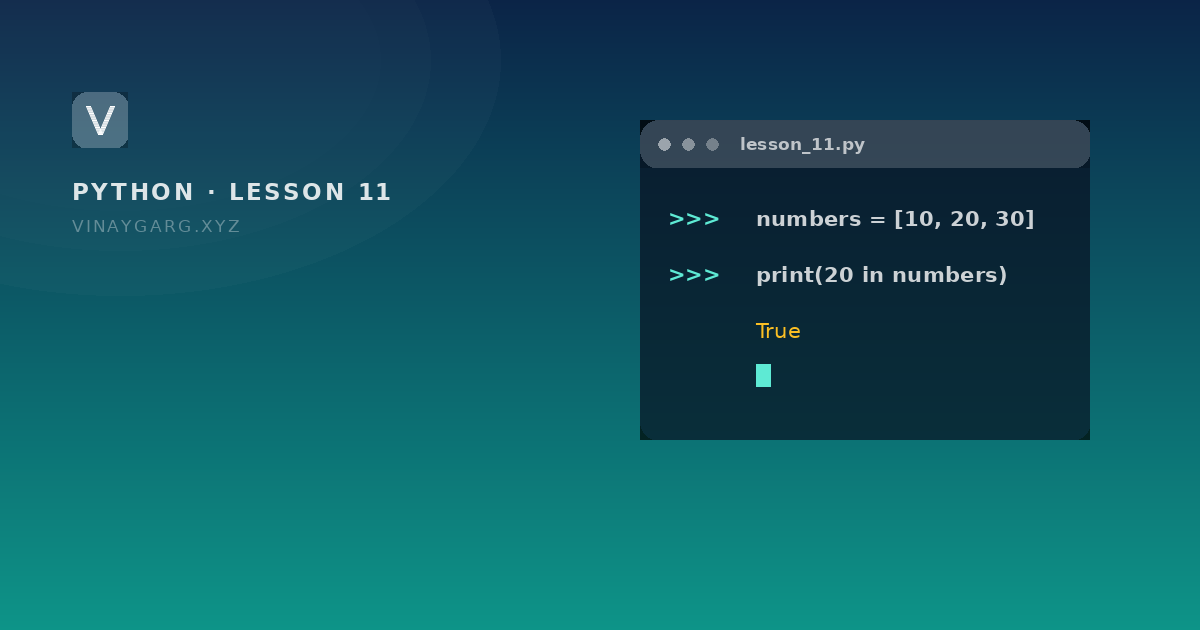
print(20 in numbers)           # True
print(40 in numbers)           # False

marks = {"maths": 88, "science": 91}
print("maths" in marks)        # True, the key
print(88 in marks)             # False, values are not tested

letters = {"a", "b"}
print("b" in letters)          # True

a = [1, 2, 3]
b = [1, 2, 3]
c = a
print(a == b, a is b)          # True False
print(a is c)                  # True

value = None
print(value is None)           # True, the usual test for None
How it works, step by step
"easy" in textsearches inside the string. For text, membership means "is this a substring".20 in numberswalks the list and compares each item with 20."maths" in markschecks the dictionary's keys. To test a value you would write88 in marks.values().a == bcompares element by element, so two separate lists with the same items are equal.a is bcompares the objects, so it isFalse: they were created by two different statements.a is cisTruebecausec = acopies the reference, not the list.
What it prints
True
True
True
False
True
False
True
True False
True
True
Which one should you use
Use in constantly — it is clear and fast enough for normal sizes. Use is only for None, True and False, where it is the recommended test. For everything else, compare with ==; two equal numbers or strings may or may not be the same object, and the answer can differ between Python versions.
Common mistakes
if x is 5— usex == 5. Small integers are cached and it happens to work, then fails for large ones.if "maths" in marksexpecting the value 88. It tests keys only.- Using
inon a set of lists: sets need hashable items, so a list inside a set fails at creation.
Practice
Try these before moving on. Each one uses only what this lesson covered.
- Check whether the word "python" appears in a sentence you store in a variable.
- Store five subject names in a list and print whether "Maths" is in it.
- Create two lists with the same values and print both `==` and `is` results, then explain the difference in a comment.
Sources
Frequently asked questions
What is the difference between == and is in Python?
== compares values, so two separate lists with the same items are equal. is compares objects, so those two lists are different objects and is returns False. Use == unless you are testing None.
What does the in operator do?
It tests membership: whether a value appears inside a string, list, tuple, dictionary or set. It returns True or False and can be negated with not in.
Does in work on dictionary values?
No. On a dictionary, in checks the keys only. To test a value, write 88 in marks.values().
Why does x is None work but x is 5 does not?
None is a single object, so identity is the right and recommended test. The number 5 may be represented by several objects, and small-integer caching makes is unreliable for numbers.