Lesson 20: Sets: unique values and set operations
A set keeps values with no duplicates and no order. That makes it the fastest way to remove repeats from a list and the natural tool for comparing two groups: what is shared, what is only in one.

In short
- A set is written with curly brackets of values, or `set()`, and never keeps duplicates.
- Sets are unordered, so there is no index and no slicing; you test membership instead.
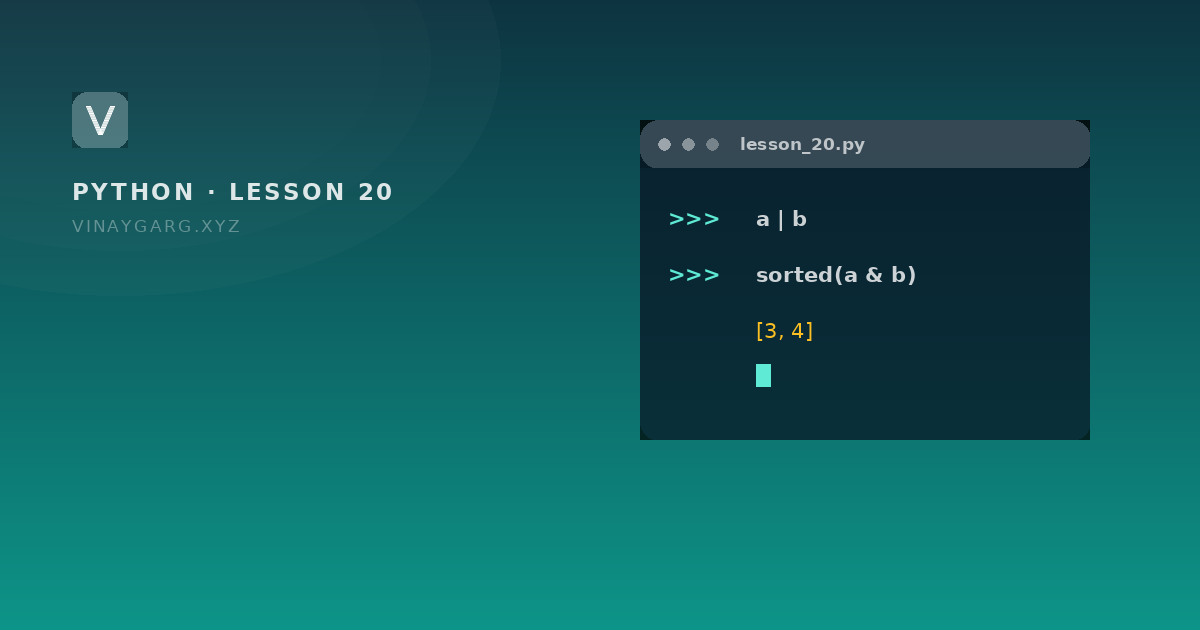
- Union `|`, intersection `&`, difference `-` and symmetric difference `^` compare two sets.
- `set(list)` is the shortest way to remove duplicates while keeping the values.
4
set operations: union, intersection, difference, symmetric difference
Python docs
0
duplicates a set will store
Python docs
What a set is
A set is an unordered collection of unique values. Add the same value twice and the second one is simply not there. Because there is no order, there is also no index: s[0] is an error.
marks = {45, 67, 89, 67}
print(marks)          # {45, 67, 89} — the repeat is gone
The program
# sets.py — uniqueness and the four comparisons

a = {1, 2, 3, 4}
b = {3, 4, 5}

print(sorted(a | b))    # [1, 2, 3, 4, 5]  union
print(sorted(a & b))    # [3, 4]           intersection
print(sorted(a - b))    # [1, 2]           difference
print(sorted(a ^ b))    # [1, 2, 5]        symmetric difference

a.add(6)
a.discard(2)
print(sorted(a))        # [1, 3, 4, 6]
print(5 in a, len(a))   # False 4

rolls = [11, 12, 11, 13, 12]
print(len(rolls), sorted(set(rolls)))   # 5 [11, 12, 13]
How it works, step by step
a | bis the union: every value that appears in either set, without repeats.a & bis the intersection: only the values in both.a - bis the difference: values inathat are not inb.a ^ bis the symmetric difference: values in exactly one of the two.add()inserts one value,discard()removes one if present.remove()does the same but raises an error when the value is absent.set(rolls)throws away duplicates, andsorted()is used only so the output has a predictable order.
What it prints
[1, 2, 3, 4, 5]
[3, 4]
[1, 2]
[1, 2, 5]
[1, 3, 4, 6]
False 4
5 [11, 12, 13]
Sets compared with lists and dictionaries
| Collection | Order | Duplicates | Typical use |
|---|---|---|---|
| List | kept | allowed | A sequence of records |
| Tuple | kept | allowed | A fixed group of values |
| Dictionary | kept | keys unique | Lookup by name |
| Set | none | not allowed | Uniqueness and comparisons |
Common mistakes
{}creates an empty dictionary, not an empty set. Useset().- Expecting an order from a set and printing it directly. Sort it first when the order matters to a reader.
- Putting a list inside a set. Set items must be hashable, so use a tuple.
Practice
Try these before moving on. Each one uses only what this lesson covered.
- Create a set of five numbers with one duplicate and print it, explaining what happened.
- Take two sets, one of students who play cricket and one of those who play football, and print both groups and only the shared names.
- Remove duplicates from a list of roll numbers with `set()` and print the count before and after.
- Check whether one set is a subset of another with `<=`.
Sources
Frequently asked questions
What is a set in Python?
An unordered collection of unique values. It removes duplicates automatically, supports fast membership tests, and provides union, intersection and difference for comparing collections.
How do I remove duplicates from a list?
Convert it: set(my_list). That gives you the unique values, though in no particular order. Wrap it in sorted() if you need them ordered.
What is the difference between a set and a list?
A list keeps order and allows duplicates, and you reach items by index. A set has no order, no duplicates, and is used for membership tests and comparisons.
What does a - b mean for two sets?
The difference: the values that are in a but not in b. The order matters, because b - a usually gives a different answer.